
Trades & Services — Sydney, NSW
Sydney Plumbing Business Unifies Three Locations on One Phone System

1
Unified system across 3 locations
50%
Reduction in monthly phone costs
100%
Call analytics visibility
$0
Hardware — uses existing devices
Overview
Consider a plumbing business operating across three locations in the greater Sydney area — one in the inner west, one on the northern beaches, and a newer depot in the south-west. Between the three sites, the business employs 12 field technicians and 4 office staff. Each location had its own separate phone line, its own voicemail box, and its own way of doing things. When a customer called one location and needed to speak to someone at another, the call had to be transferred manually — which often meant hanging up and calling back.
The owner had been running the business for 11 years and had watched it grow from a single van to a multi-site operation. But the phone system had never kept pace. Field technicians were giving out their personal mobile numbers to clients, which created problems when staff left. There was no way to record calls, no way to see how many calls were being missed, and no way to present a consistent, professional image across all three locations.
After switching to Click2Call's Cloud PBX, the business unified all three locations under a single phone system, reduced its monthly phone bill by 50%, and gave every field technician a business number on their existing smartphone — without buying a single piece of hardware.
The Challenge
The core problem was fragmentation. Three separate phone lines meant three separate bills, three separate voicemail boxes, and three separate caller experiences. A customer who had previously dealt with the inner west office and then called the northern beaches number would be treated as a new caller. There was no shared contact history, no way to see if the customer had already spoken to someone that day, and no way to transfer the call without putting the customer on hold and hoping someone picked up at the other end.
The field technician problem was equally frustrating. When a job ran over or a customer needed to reach the technician on site, they would call the technician's personal mobile. This meant clients had direct access to personal numbers, which created boundary issues and made it difficult to manage after-hours calls. When a technician left the business, clients would continue calling their personal number — and the business had no way to redirect those calls.
The owner also had no visibility over call volumes. There was no way to know how many calls were coming in each day, how many were being missed, or which location was the busiest. Decisions about staffing and resourcing were being made on gut feel rather than data.
The Solution
The business moved to Click2Call's Cloud PBX with 12 user seats at $25 per user per month. Each field technician received an extension on the Click2Call mobile app, installed on their existing smartphone. Each office received a dedicated local number. All three numbers were configured to ring through to the same ring group, so any available staff member — regardless of location — could answer an incoming call.
The three existing landline numbers were ported across to Click2Call. The port took 8 business days and cost $150 (three numbers at $50 each). From the day the port completed, all three numbers rang into the same Cloud PBX system. Calls could be transferred between extensions instantly, regardless of which location or which technician's mobile the call was on.
Field technicians no longer needed to give out personal numbers. When a client calls the business number and asks for a specific technician, the office transfers the call to the technician's Cloud PBX extension on their mobile app. The client sees the business number, not the personal mobile. When the technician leaves the business, the extension is simply reassigned.
Call recording was enabled across all extensions. The AI Receptionist was configured to handle after-hours calls, taking a detailed message and sending it to the on-call supervisor by email. The owner now reviews a daily call report showing total calls, missed calls, and average answer time across all three locations.
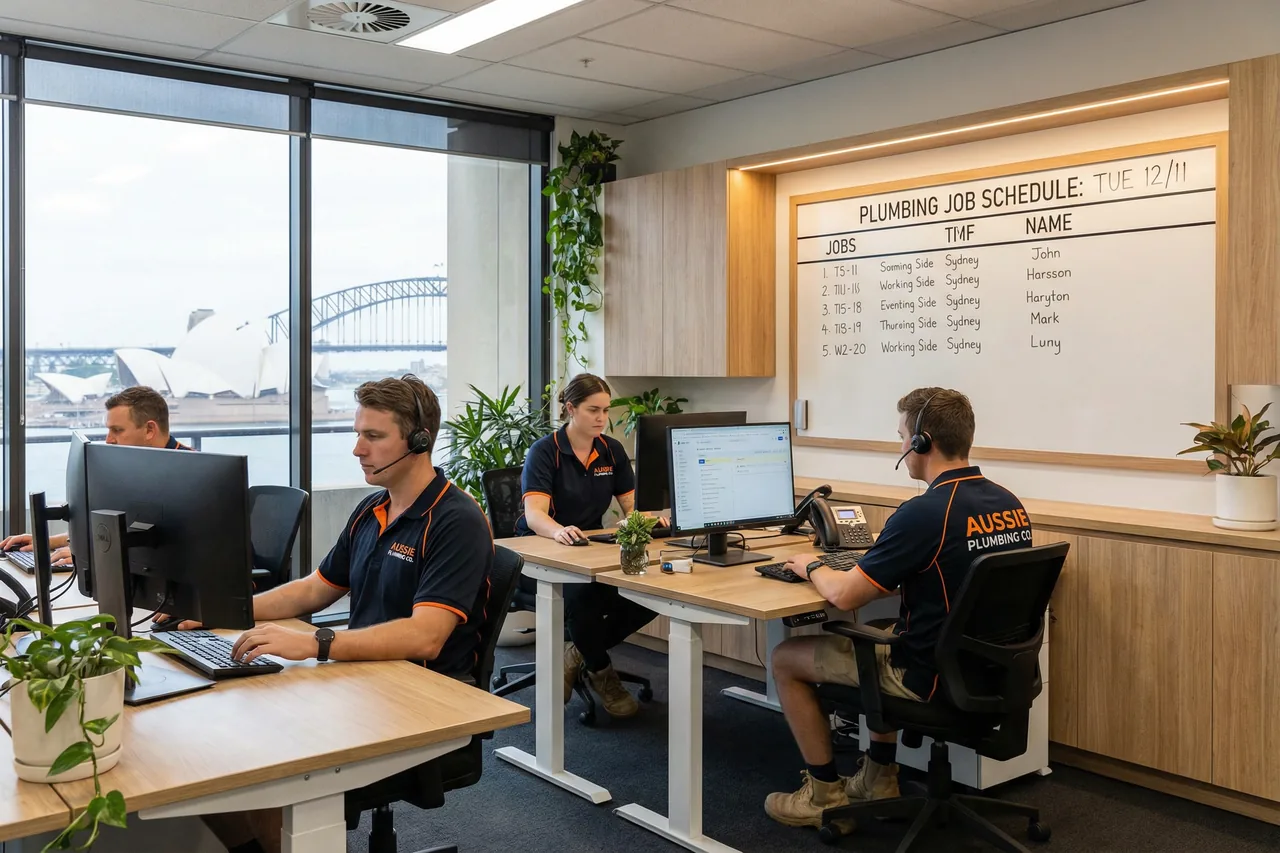
The dispatch team managing jobs across three Sydney locations from a single unified phone system.
The Results
The most immediate result was the cost reduction. The three separate landline plans had been costing approximately $600 per month in total. The Click2Call system for 12 users costs $300 per month — a saving of $300 per month, or $3,600 per year. And unlike the old system, the new one includes call recording, voicemail to email, mobile app access for all technicians, and a full call analytics dashboard.
The field technician experience improved significantly. Technicians now take and make calls through the Click2Call mobile app, showing the business number to clients at all times. The owner reported that the first week after going live, two technicians commented that they felt more professional — they were no longer having to explain to clients why they were calling from a different number.
The call analytics data revealed something the owner had not expected: the northern beaches location was missing approximately 22% of incoming calls during the lunch hour. A simple adjustment to the ring group — routing lunch-hour calls to the inner west office as backup — resolved the issue within a week. That kind of insight had simply not been available before.
The business has since added a 1300 number for $10 per month, which is used in all advertising. The 1300 number routes into the same Cloud PBX system, so calls are answered by whichever staff member is available across all three locations.
"We were paying more for three separate phone lines than we now pay for the entire Click2Call system — and the old system didn't have half the features. The ability to see missed calls across all three locations in one dashboard has been invaluable. We fixed a problem we didn't even know we had."
Frequently Asked Questions
One System for Every Location, Every Technician
Click2Call's Cloud PBX connects your whole team — office, field, and multiple sites — under one professional phone system. Start your free trial today, no credit card required.